

European industry strangled
The European industry is not doing well, and Germany is a prime example of this decline. Stagnating production, expensive energy, and delayed investments are putting severe pressure on the backbone of the economy, with no sign of improvement in sight.
Summary:
European stock market performance masks underlying problems
Traditional sectors are losing ground
Former growth engine Germany is faltering
Energy is Europe's Achilles heel
Climate policy is hitting competitiveness hard
European industry is facing tough times. There is a deluge of profit warnings, reports of layoffs, stagnating production, and companies reconsidering their investments. What was once the backbone of the European economy, now seems to be sinking deeper and deeper into a structural crisis.
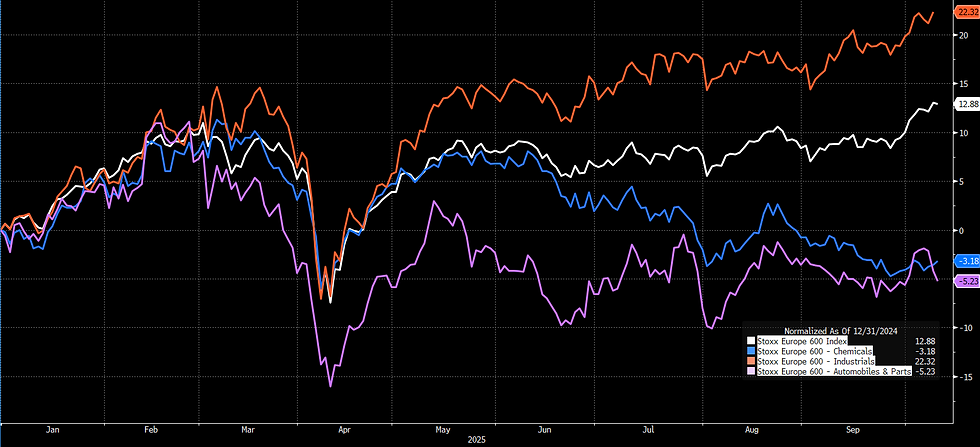
The annual profit of almost 13% for the broad European Stoxx 600 index therefore paints a highly distorted picture. Everything seems fine on the surface, but underneath there is a disturbing reality. The differences between companies are considerable.
On the one hand, the industrial sector appears to be performing excellently, with growth of more than 22%. However, this increase is largely driven by the staggering share price gains of defense companies such as Rheinmetall and Rolls Royce. These companies are benefiting greatly from geopolitical tensions and increased defense budgets following the raising of NATO standards.
For the traditional pillars of the European economy, the picture on the stock market is much less rosy. The chemical sector has already lost more than 3% this year, while the automotive industry, including suppliers, has fallen by more than 5%.
German recovery fails to materialize
Germany, which until fairly recently was the growth engine of the European economy, is a major bottleneck. Earlier this year, after the elections, a new wind began to blow there, partly due to the partial lifting of the Schuldenbremse (debt brake). The impulses this generates are taking some time to translate into actual economic activity.
For the time being, the harsh reality is different. The latest production figures for August spoke volumes: a decline of 4.3% compared to the previous month, with the automotive industry hitting a dramatic low with a contraction of 18.5%. This is not a temporary dip or a seasonal effect but rather resembles a structural trend.
The German sector is therefore sounding the alarm. According to industry association VDA, 80% of medium-sized automotive companies are now postponing investments in Germany, relocating them abroad, or canceling them altogether. The German Chemical Industry Association (VCI) speaks bluntly of a “persistent crisis atmosphere.” According to the organization, the promised “autumn of reform” threatens to sink into a long hibernation without concrete results.
The German automotive sector has been in dire straits for some time. This has everything to do with the transition to electric cars. Chinese EV manufacturers such as BYD, Nio, and Xpeng produce electric vehicles that are at least equivalent in quality but at significantly lower prices. Profit warnings are piling up, not only among the major car manufacturers but throughout the entire supply chain.
Expensive energy
An important explanation can be found in the energy market, where Europe is in a painful stranglehold due, among other things, to the virtual halt in imports of cheap Russian gas and Germany's decision to completely phase out nuclear energy.
The direct consequence is that Europe is now at the mercy of extremely expensive American liquefied natural gas (LNG) and the vagaries of the international energy market. High energy prices for European companies are undermining the competitiveness of energy-intensive sectors such as chemicals and steel.
At the same time, Europe is creating an additional obstacle for itself by setting itself the goal of taking the lead in reducing CO2 emissions. Part of this involves the widespread introduction of CO2 taxes to combat climate change.
This is undoubtedly a noble goal, but from an economic perspective, the impact is disastrous. The European Union accounts for only 6% of global CO2 emissions. This contrasts sharply with China (approximately 30%), the United States (11%), and now India (8%). They are watching Europe pricing itself out of the market with climate measures that have limited impact at the global level.

Outlook uncertain
Europe has highly educated policymakers, strong institutions, and a rich industrial history. Yet policy initiatives continue to undermine its competitive position. China and the US in particular are operating from a position of strength, in contrast to a divided and stagnating Europe.
A number of companies are choosing to relocate or set up operations in China or the US. For example, more and more industrial companies are deciding to scale back or even cancel investments in Rotterdam, for example.
Although this may seem sensible at first glance, it is a time-consuming and costly process. A good example of this is the German company BASF, the largest chemical company in the world. In mid-2018, it announced plans to build a huge chemical complex in Zhanjiang, China. That complex will not be fully operational until 2026—eight years later.
No safe haven
European industrial companies are currently far from being safe havens for investors, despite steadily declining valuations. The apparent resilience of the Stoxx 600 masks a simmering crisis that is affecting the core of the European economy.
One-sided climate policy has destructive consequences. Europe is becoming less and less competitive with China and the US. The extremely high regulatory burden complicates matters. Germany, once the engine of growth, is increasingly becoming Europe's Achilles heel. And all this is separate from the budgetary problems in France. It is therefore all hands-on deck for Europe.
Sources: iex.nl (Teun Verhagen), Bloomberg, Jones et al., OurWorldInData.org, Hiki Liu, ChatGPT


Comments